Thursday, August 10, 2023

Maigret and the Gangsters by Georges Simenon

Originally titled Maigret, Lognon and the Gangsters, this was the first Maigret novel Simenon wrote after moving to live in Connecticut. It's a bit of a wild plot with car chases, gun fights, beatings, kidnapping, tough guys, floozies and lots of booze. 

Lognon is the sad sack detective who witnesses a body being thrown from a car on to the pavement, with the car speeding off. Lognon goes to a bar close by where there was a telephone and then glanced up to see a second car leaving the street and when he went back to where he had seen the body, found that the body wasn’t there. Maigret has to deal with a brace of American crooks in Paris and their different and decisive way of dealing with the police.

Simenon books are reliably enjoyable and quick to read. With this one the writing is as crisp and atmospheric as can be expected from the hugely talented Simenon.


Friday, July 13, 2012

12-07 All Hell Let Loose by Max Hastings

All Hell Let Loose: The World At War 1939-1945 (2011) by Max Hastings

Who needs another overview of the Second World War, right? I'd heard that Max Hastings was a bit polemic when it came to his histories but that this was one of his best written and most accessible books.

It turns out to have been a fantastic read. What he does in this book is not only to present a rough overview of the war from wherever it might be taking place but he also compiles small personal anecdotes about how it affected both combatants and civilians.

I would suggest that this is the best single volume history of the war that I have read.

"Readers who know Max Hastings the dyspeptic opinion-monger - indeed, some who have read his narrower military histories - may be surprised or awed by this book.

Not another doorstop chronicle of the Second World War, this is his masterpiece: humane, sceptical, vivid, authoritative, quite free of jingoism. He delivers "bottom-up... experiences", of civilians and combatants alike.

From him you might expect the panoramic set-pieces, the grand strategy and landmark battles of 1939-1945. He draws superbly too on diaries, journals and reports.
The epic closes without a whiff of triumphalism, leaving just a great sadness behind."

- The Independent

Sunday, March 04, 2012

12.04-06 Sword Of The Spirits Trilogy by John Christopher

The Prince In Waiting (1970)
Beyond The Burning Lands (1971)
The Sword Of The Spirits (1972)

I finally ran across some copies of this John Christopher YA trilogy (I seem to be surrounded by trilogies this year). I had, of course, read The Tripods the science fiction series about invaders that enslave the worlds children. This series again has an apocalyptic undercurrent but is placed much more firmly in the fantasy world.

The world is England well after the apocalypse. The record is vague but before man destroyed themselves in war the earth itself destroyed most humankind with natural disasters. Now, hundreds of years later society exists feudally with various city-states existing independently. Each city has a Prince and below him a number of martial Captains. Common non-mutated people make up the bulk of the population but below them are Dwarves who are respected craftsmen (armorers, carpenters and the like) and then finally a servant class of people that show some mutation - so called "polymufs".

The series follow Luke, the son of a low born Captain in the City of Winchester. Through a series of events Luke's father is named Prince of Winchester and Luke the Prince in Waiting.

In the second book Luke travels across the Burning Lands (still active volcanic area) and discovers another city state where the rigid laws and rules adhered to on the other side do not apply. Technology which is shunned at home is here openly discussed and mutation not a barrier to class advancement. Luke performs a feat for the king and is promised his daughter.

The final book follows Luke as he attempts to fulfill his destiny and become the Prince of all the lands.

While I didn't find these books nearly as enjoyable as the Tripods series I think they have a sort of low key depth that would be good for young adults to read. Luke has hubris but his constant set backs tend to moderate hi from being an annoying character. The most interesting subplot involves religion. Most people are followers of the Spirits believing that there is an overarching morality. The Seers are the representatives of the Spirits yet the true purpose of the men who act as Seers is hidden to most for reasons that become apparent later in the books. Further, there are Christians in these cities but they are quite marginalized and criticized.

Altogether a nice group of books to have in the library for your young children.


Wednesday, February 29, 2012

12.03 The Steel Remains by Richard Morgan

The Steel Remains (2008) by Richard Morgan

I'm a pretty big fan of Richard Morgan's science fiction writing. He walks a fine line between being a populist writer and having some style of his own. Being stuck in the ghetto of science fiction has never helped him sell books though. I was quite surprised to run across this book - the first in a purported trilogy - in which he writes in the fantasy genre.

Morgans hook, if you will, is that he fairly liberally uses sex and violence in his novels. Well in this book he has made his main character explicitly and unapologetically gay. That in and of itself is no big deal but many of the criticisms of the book are that he takes it too far. I had read the reviews beforehand and was somewhat prepared. And actually for about the first 2/3 of the book he handles it quite well. Then there are a couple of scenes that get damn close to porno.

That aside, Morgan has developed a cool world. Ringil is a nearing middle age war hero. His world was invaded by a race of Lizard-Men and only by teaming up with another otherworldly race were they able to beat back the invasion. Ringil lives an easy life sponging off his fading glory. Turns out his mother, a noble, needs him to come back to the city and rescue a kidnapped cousin.

This set up leads ultimately to a conflict with another race bent upon taking over this world. There are a lot of SF tropes underlying this fantasy adventure.

Overall, I liked this book a lot but I would agree with other reviewers in that because Morgan made his hero so non-traditional he felt he had to over do it with the graphic detail. I guess one could argue that if he had detailed hetero sex scenes then there would be far fewer complaints. I think that for the most part he handled that character attribute well - there we just a few missteps.

12.02 Mockingjay by Suzanne Collins

Mockingjay (2010) by Suzanne Collins

Oh merciful heavens! I cannot believe that I finished this "dystopian" trilogy. I don't even know what to say about this book. At least the second one had another Hunger Game which alleviated the need to constantly listen to the unstable whining from Katniss, the ostensible heroine.

I'd like to go back and have just read the first book all by itself. Wait for the movie.

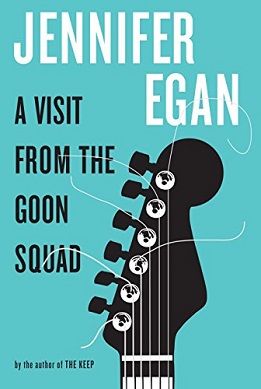
12.01 A Visit From The Goon Squad by Jennifer Egan

A Visit From The Goon Squad (2010) by Jennifer Egan


You know, I really need to be more careful about this habit I have of occasionally getting sucked into reading these contemporary "prize-winning" novels. The hype more often than not masks poor storytelling. Anyway, I liked the sound of this book. It seemed to have an 80s music vibe and had come out atop many folks best of 2011 reading lists.

In the end though I was underwhelmed. The story (if you can call it that) is loosely based on a group of young people in the 80s who form a moderately successful band. The chapters are really interconnected short stories that feature many of these characters in the contemporary world. Some are successful, some not but most are still involved in the music industry.

The author obviously tried to do something different with the book by playing with structure - there is a whole chapter laid out like a PowerPoint presentation - to varied effect. Don't waste your time here.

Tuesday, January 17, 2012

11.24 West Coast Blues by Jaques Tardi / Jean-Patrick Manchette

West Coast Blues by Jaques Tardi (art)  / Jean-Patrick Manchette (writer)


George Gerfaut, aimless young executive and desultory family man, witnesses a murder and finds himself sucked into a spiral of violence involving an exiled war criminal and two hired assassins. Adapting to the exigencies of his new life on the run with shocking ease, Gerfaut abandons his comfortable middle-class life for several months (including a sojourn in the countryside after an attempt to ride the rails turns spectacularly bad) until, joined with a new ally, he finally returns to settle all accounts... with brutal, bloody interest. Released in 2005, West Coast Blues (Le Petit bleu de la côte ouest) is Tardi’s adaptation of a popular 1976 novel by the French crime writer Jean-Patrick Manchette. (The novel had been previously adapted to film under the more literal title Trois hommes à abattre, and was released in English by the San Francisco-based publisher City Lights under the English version of the same title, 3 to Kill.) Tardi’s late-period, looser style infuses Manchette’s dark story with a seething, malevolent energy; he doesn’t shy away from the frequently grisly goings-on, while maintaining (particularly in the old-married-couple-style bickering of the two killers who are tracking Gerfaut) the mordant wit that characterizes his best work. This is the kind of graphic novel that Quentin Tarantino would love, and a double shot of Scotch for any fan of unrelenting, uncompromising crime fiction. Nominated for two 2010 Will Eisner Comic Industry Award (Best Adaptation from Another Work; Best U.S. Edition of International Material).

11.23 Tropic Moon by Georges Simenon

Tropic Moon by Georges Simenon

I didn't realize I had a couple of more reviews to wrap up for 2011. Tropic Moon is such a great book. Simenon leaves you with a palpable sense of anxiety as you read the novel.

Please head over and read the quality summaries and opinions of Buzby and Olman on Tropic Moon.


Monday, December 19, 2011

11.22 Catching Fire by Suzanne Collins

Catching Fire (2009) by Suzanne Collins

Against all odds, Katniss Everdeen has won the annual Hunger Games with fellow district tribute Peeta Mellark. But it was a victory won by defiance of the Capitol and their harsh rules. Katniss and Peeta should be happy. After all, they have just won for themselves and their families a life of safety and plenty. But there are rumors of rebellion among the subjects, and Katniss and Peeta, to their horror, are the faces of that rebellion. The Capitol is angry. The Capitol wants revenge. 

Jesus, I was warned that if I continued on into this series I would be sorely disappointed. Not that I had any high expectations but the first book was a tolerably entertaining read. For this second novel the author seems to have gotten grander expectations of creating a story writ larger than just the love triangle of Katniss.

Understandably she couldn't just write another Hunger Games but the good stuff about the first book was a fairly low level of moping about the situation and actually being pretty competent when it came to fighting in the Games. This time around though it's all boohoo for me and the heroine time and again needs saving by the better, more well informed men around her.

I'm hard pressed to find a reason to read the third one. I'll just have to wait for the inevitable movie.


Friday, December 16, 2011

11.21 The Prone Gunman by Jean-Patrick Manchette

The Prone Gunman (1981) by Jean-Patrick Manchette


The Prone Gunman, the last crime novel Manchette wrote, mixes two well-worn plotlines to cruelly ironic effect: the hit man who wants out of the game and the working-class boy made good who comes home to claim his girl. 


Martin Terrier grows up poor in a puddle of a provincial town, and has the misfortune to fall for the daughter of the town's one factory owner, who forbids him from seeing her and sends him packing through the service entrance. Young Terrier makes his love promise to wait 10 years for him, swearing, "I will return, I will kill them, I will drag them through the shit, I will make them eat shit." He does, but not in quite the way he had hoped: When the decade is up, Terrier, an accomplished assassin, wants to break free from his employer—a CIA-like American group referred to only as "the company"—and whisk away his old lover, now an alcoholic housewife who finds him absurd. The company, of course, does not want to let Terrier go, and blood and mayhem follow him home.


I'm continuing my little love affair with the short French crime novels of Jean-Patrick Manchette. This one, like many of the others has been adapted into a graphic novel drawn by the Frenchman, Jaques Tardi. I haven't read it yet but I suspect that much of the novel might be lost in the visual translation.

The novel has some insanely cinematic violent scenes but the roughest stuff is the unceasing and crushing disappointment that the hero must endure. It is really a fine little book with some very European sensibilities.


Thursday, December 15, 2011

11.20 Zoo Station by David Downing

Zoo Station (2007) by David Downing

By 1939, Anglo-American journalist John Russell has spent over a decade in Berlin, where his son lives with his mother. He writes human-interest pieces for British and American papers, avoiding the investigative journalism that could get him deported. But as World War II approaches, he faces having to leave his son as well as his girlfriend of several years, a beautiful German starlet. 


 When an acquaintance from his old communist days approaches him to do some work for the Soviets, Russell is reluctant, but he is unable to resist the offer. He becomes involved in other dangerous activities, helping a Jewish family and a determined young American reporter. When the British and the Nazis notice his involvement with the Soviets, Russell is dragged into the murky world of warring intelligence services.


As mentioned in my previous review of the Kerr book I heard about this author through my father in law who read a number of the Downing books set in pre-war Berlin. I wanted to read both authors close together to compare and contrast their styles. I have to say that Downing wins out for me in the end.

His hero, John Russell, is not a detective but a journalist who is essentially a native Berliner. He sees with a Western perspective though the writing on the wall as Germany is changing into a dictatorship. Many of the upper middle class Berliners that he is friends with including his girlfriend seem to have their head in the sand with regards to the Nazis.

Additionally Downing doesn't make the book into a city tour so much as Kerr does. He still uses the city as a character but allows it to unfold much more naturally. For most of the book he gets around by public transportation which allows for a slower pacing. While the mysteries here may not be as compelling I think this novel draws the reader into the world of Berlin much more deeply.

11.19 March Violets by Philip Kerr

March Violets (1989) by Philip Kerr


Bernhard Gunther is 38 years old, a veteran of the Turkish Front, and an ex-policeman. He's also a private eye, specializing in missing persons, which means that he's a very busy man. Because this is Berlin 1936, and people have a nasty habit of disappearing in Hitler's capital. 


 A cluster of diamonds sets Bernie off on a new case -- diamonds and a couple of bodies. The daughter and son-in-law of Hermann Six, industrialist millionaire and German patriot, have been shot dead in their bed and a priceless necklace stolen from the safe. As Bernie pursues the case through seedy Berlin nightclubs, the building sites for the new autobahns, and even the magnificent Olympic Stadium where Jesse Owens is currently disproving all the fashionable racist theories, so he's led inexorably into the cesspit that is Nazi Germany, travelling the murky paths from the police morgue where missing persons usually end up to, finally, Dachau itself.


This past summer my father in law had been reading a number of crime novels by David Downing that are set in pre-war Berlin. I looked for them in the library but couldn't remember the author. It turns out there is another crime author that writes in the same milieu, Philip Kerr. So I got this book.

It's a great period to write in. The threat of impending war, the growing Nazification of the Germans and Berlin of course was such a cosmopolitan city then. The crime story here is good although somewhat convoluted. Kerr seems to have felt the need to have his hero pass through every famous place in Berlin 1936. Gunther is the stereotype of the American hardboiled crime detective: disheveled and hard drinking. Unfortunately, my only major complaint about the novel is the section near the end where the hero goes to the concentration camp. The scenes aren't poorly written it is just that the tone is so glaringly different from the rest of the book that it throws you off.

Wednesday, December 14, 2011

11.18 The City & the City by China Miéville

The City and the City by China Miéville

Inspector Tyador Borlú, of the Extreme Crime Squad in the European city-state of Besźel, investigates the murder of Mahalia Geary, a foreign student found dead with her face disfigured in a Besźel street. He soon learns that Geary had been involved in the political and cultural turmoil involving Besźel and its twin city of Ul Qoma. His investigations start in his home city of Besźel, lead him to Ul Qoma to assist the Ul Qoman police in their work, and eventually result in an examination of the legend of Orciny, a rumoured third city existing in the spaces between Besźel and Ul Qoma.
This is actually the first Mieville book that I have been able to make it through. He's a huge award winner in the SFF world and has even done some writing for roleplaying games. I think the reason that I was able to enjoy the book is that it is a science fiction novel wrapped in a crime procedural.

The concept of two cities existing side by side with innumerable interstices was a difficult one to be drawn in to. He is a skillful writer though and as you push on through the book he makes the idea plausible.

I would definitely recommend this book as a place to start if you want to dip your toe into the works of China Miéville.

Saturday, October 15, 2011

11.14 The White Death by Allen F Chew

The White Death: The Epic of the Soviet-Finnish Winter War (1971) by Allen F Chew

I'm not sure how I got it in my head that I wanted to learn more about The Winter War. I knew there had been a series if brutal battles as the beginning of WWII with the Soviets trying to invade Finland. I also had a notion that the Finns were somehow tied in with the Nazis through the remainder of the war. A little internet research led me this book by Allen Chew which seems to be the most well regarded English language account of this brief period.

As usual with anything associated with this period everything Soviet begins with Stalin. The Great Purge of the late 1930s left the Soviet army bereft of experienced officers for the most part.  Further, Stalin decided he wanted to reclaim territory lost in the Russian Civil War (1917-23). Although Finland espoused neutrality in the war, Russia worried of fascist influence there and had concerns about the geographic exposure of Leningrad. Once Germany invaded Poland

The book is quite good in that it combines a clear account of the politics as well as the battle accounts. The Finns did very well initially because of good leadership and home field advantage. The buggers could ski a whole division through the night, attack and escape back across the frozen landscape. Eventually though the Soviets were able to prevail through the sheer weight of manpower and armaments. The Finns finally sued for peace and ceded large amounts of territory.


Thursday, October 13, 2011

11.13 Thirteen by Richard K Morgan

Black Man aka Thirteen (2007) by Richard K Morgan

I am really, really far behind on posting about my reading but as I finally seem to be finding a taste for the written word I feel I should get some of these out of the way.

From the publisher:

"Carl Marsalis is a traitor, a bringer of death, a genetic freak and an unwelcome reminder of all that is dark in the human psyche – he in every sense of the word a Black Man. And right at the moment he’s beyond the UN’s jurisdiction, banged up in a Florida jail for financing an illegal abortion. So when the US police call, Carl cuts a deal.
The 13s are genetically engineered alpha males, designed to fight the century’s last conflicts. But men bred and designed to fight are dangerous to have around in peacetime. Many of them have left for Mars, but one has returned. Somehow he survived the journey to Earth, and now a series of brutal slayings has erupted across America. Only Carl can stop him.
And so begins a frenetic man hunt and a battle for survival. And a search for the truth about what was really done with the world’s last soldiers."

Morgan writes in a style that could be described as Airport sci-fi. It is very accessible, paced quickly and tends to wrap up loose ends neatly.  I've read a bunch of his other books and I would say that this one ranks somewhere in the middle. It was fun but at times so outlandish as to take me right out of the story.


Wednesday, August 31, 2011

11.17 Fatale by Jean-Patrick Manchette

Fatale (1977 ) - by Jean-Patrick Manchette

I came across this guy when I was flipping through some graphic novels at the comic store. Fantagraphics has put out some illustrated adaptations of this French crime novelist who wrote in the 70s. Few of his books have been translated but the library had recent NYRB imprint.

The novel is short but taut. Aimée is kind of a grifter/hitwoman looking for her next job. She is efficient and calculating but still remains human, not cold.

I have to say that the tone and style of this novel reminded me a lot of the books of Patricia Highsmith.

Wednesday, August 17, 2011

11.16 The Hunger Games by Suzanne Collins

The Hunger Games (2000) by Suzanne Collins

Jeebuz! Is this ever the year of The Hunger Games. Not only are they making a movie but it has recently been read and reviewed by Kate, Olman and meezly. I had to give it a try to see what all the fuss is about.

In a future world 12 Districts are ruled over by a totalitarian government. There is an annual televised event where one teen from each District is chosen to compete in a ritualized fight to the death with the last survivor winning a life of fame and comfort. I was a bit surprised that more was not made of the similarities to the Japanese book (and manga and film) Battle Royale. That was the first thing that I thought of. It just goes to show you that there continues to be opportunities for making money off of translating foreign properties into something palatable to the North American audience.

To be fair, the book was quite readable and well paced.


11.15 The Slynx by Tatyana Tolstaya

The Slynx (2000) by Tatyana Tolstaya


Two hundred years after civilization ended in an event known as the Blast, Benedikt isn’t one to complain. He’s got a job—transcribing old books and presenting them as the words of the great new leader, Fyodor Kuzmich, Glorybe—and though he doesn’t enjoy the privileged status of a Murza, at least he’s not a serf or a half-human four-legged Degenerator harnessed to a troika. He has a house, too, with enough mice to cook up a tasty meal, and he’s happily free of mutations: no extra fingers, no gills, no cockscombs sprouting from his eyelids. And he’s managed—at least so far—to steer clear of the ever-vigilant Saniturions, who track down anyone who manifests the slightest sign of Freethinking, and the legendary screeching Slynx that waits in the wilderness beyond.


As you can see from the above description this is an odd book. It is dystopian but primarily in a literary sense. There are many allusions to famous Russian literary tropes that I'm afraid many of which passed over my head.


In the end, a fundamental lack of narrative made this book something of a drag to read.

Friday, June 10, 2011

11.12 The Tourist by Olen Steinhauer

The Tourist (2009) by Olen Steinhauer

This is a big time modern spy novel with all the push of a major publishing house behind it. I believe it has already been optioned as a movie starring George Clooney. Pretty much an airport novel. My wife, a non-spy novel reader, had quite enjoyed this one and I got sucked in by the cover blurb comparisons to Le Carre.

Milo Weaver spent many years as a CIA Tourist, a highly trained, zero-identity operative. An operation gone bad on Sept 11, 2001 (what coincidence!) made Weaver decide to get out of the game. After several years of domesticity he's drawn back in to the world of the Tourists. An international assassin, The Tiger (!), who he had been hunting for years finally makes contact and gives Weaver some shattering information.

It wasn't the worst book ever. The writer knows what he is doing and paces the story well. However, other than bringing in post-9/11, Homeland Security type setting there was very little innovative in this book. Wait for the movie.

Monday, May 23, 2011

11.11 The Instant Enemy by Ross MacDonald

The Instant Enemy (1968) by Ross MacDonald

"Lew Archer is hired by Keith Sebastian, a Los Angeles business executive, to find his daughter Sandy, a high-school senior who has run off with a homeless boy. Sebastian and his wife, living on the edge of affluent bankruptcy, seem unable to communicate with their daughter. Archer finds the runaway easily enough, but before he can return Sandy to her parents, she has participated in a violent crime. Archer’s efforts to save the girl from the consequences of her actions, and to understand those actions, involve him in a savage plot twisting deep into the past. At least one old murder and some new ones confound him and the police. Archer himself is very nearly killed by an ex-cop who wants to keep the case closed, but he finally manages to open it and let some daylight in.”

I've never actually read any R MacDonald before so this was a pleasant surprise. The writing was tight and the character of Archer was different enough to keep me interested. Worthwhile.