Thursday, December 15, 2011

11.20 Zoo Station by David Downing

Zoo Station (2007) by David Downing

By 1939, Anglo-American journalist John Russell has spent over a decade in Berlin, where his son lives with his mother. He writes human-interest pieces for British and American papers, avoiding the investigative journalism that could get him deported. But as World War II approaches, he faces having to leave his son as well as his girlfriend of several years, a beautiful German starlet. 


 When an acquaintance from his old communist days approaches him to do some work for the Soviets, Russell is reluctant, but he is unable to resist the offer. He becomes involved in other dangerous activities, helping a Jewish family and a determined young American reporter. When the British and the Nazis notice his involvement with the Soviets, Russell is dragged into the murky world of warring intelligence services.


As mentioned in my previous review of the Kerr book I heard about this author through my father in law who read a number of the Downing books set in pre-war Berlin. I wanted to read both authors close together to compare and contrast their styles. I have to say that Downing wins out for me in the end.

His hero, John Russell, is not a detective but a journalist who is essentially a native Berliner. He sees with a Western perspective though the writing on the wall as Germany is changing into a dictatorship. Many of the upper middle class Berliners that he is friends with including his girlfriend seem to have their head in the sand with regards to the Nazis.

Additionally Downing doesn't make the book into a city tour so much as Kerr does. He still uses the city as a character but allows it to unfold much more naturally. For most of the book he gets around by public transportation which allows for a slower pacing. While the mysteries here may not be as compelling I think this novel draws the reader into the world of Berlin much more deeply.

11.19 March Violets by Philip Kerr

March Violets (1989) by Philip Kerr


Bernhard Gunther is 38 years old, a veteran of the Turkish Front, and an ex-policeman. He's also a private eye, specializing in missing persons, which means that he's a very busy man. Because this is Berlin 1936, and people have a nasty habit of disappearing in Hitler's capital. 


 A cluster of diamonds sets Bernie off on a new case -- diamonds and a couple of bodies. The daughter and son-in-law of Hermann Six, industrialist millionaire and German patriot, have been shot dead in their bed and a priceless necklace stolen from the safe. As Bernie pursues the case through seedy Berlin nightclubs, the building sites for the new autobahns, and even the magnificent Olympic Stadium where Jesse Owens is currently disproving all the fashionable racist theories, so he's led inexorably into the cesspit that is Nazi Germany, travelling the murky paths from the police morgue where missing persons usually end up to, finally, Dachau itself.


This past summer my father in law had been reading a number of crime novels by David Downing that are set in pre-war Berlin. I looked for them in the library but couldn't remember the author. It turns out there is another crime author that writes in the same milieu, Philip Kerr. So I got this book.

It's a great period to write in. The threat of impending war, the growing Nazification of the Germans and Berlin of course was such a cosmopolitan city then. The crime story here is good although somewhat convoluted. Kerr seems to have felt the need to have his hero pass through every famous place in Berlin 1936. Gunther is the stereotype of the American hardboiled crime detective: disheveled and hard drinking. Unfortunately, my only major complaint about the novel is the section near the end where the hero goes to the concentration camp. The scenes aren't poorly written it is just that the tone is so glaringly different from the rest of the book that it throws you off.

Wednesday, December 14, 2011

11.18 The City & the City by China Miéville

The City and the City by China Miéville

Inspector Tyador Borlú, of the Extreme Crime Squad in the European city-state of Besźel, investigates the murder of Mahalia Geary, a foreign student found dead with her face disfigured in a Besźel street. He soon learns that Geary had been involved in the political and cultural turmoil involving Besźel and its twin city of Ul Qoma. His investigations start in his home city of Besźel, lead him to Ul Qoma to assist the Ul Qoman police in their work, and eventually result in an examination of the legend of Orciny, a rumoured third city existing in the spaces between Besźel and Ul Qoma.
This is actually the first Mieville book that I have been able to make it through. He's a huge award winner in the SFF world and has even done some writing for roleplaying games. I think the reason that I was able to enjoy the book is that it is a science fiction novel wrapped in a crime procedural.

The concept of two cities existing side by side with innumerable interstices was a difficult one to be drawn in to. He is a skillful writer though and as you push on through the book he makes the idea plausible.

I would definitely recommend this book as a place to start if you want to dip your toe into the works of China Miéville.

Saturday, October 15, 2011

11.14 The White Death by Allen F Chew

The White Death: The Epic of the Soviet-Finnish Winter War (1971) by Allen F Chew

I'm not sure how I got it in my head that I wanted to learn more about The Winter War. I knew there had been a series if brutal battles as the beginning of WWII with the Soviets trying to invade Finland. I also had a notion that the Finns were somehow tied in with the Nazis through the remainder of the war. A little internet research led me this book by Allen Chew which seems to be the most well regarded English language account of this brief period.

As usual with anything associated with this period everything Soviet begins with Stalin. The Great Purge of the late 1930s left the Soviet army bereft of experienced officers for the most part.  Further, Stalin decided he wanted to reclaim territory lost in the Russian Civil War (1917-23). Although Finland espoused neutrality in the war, Russia worried of fascist influence there and had concerns about the geographic exposure of Leningrad. Once Germany invaded Poland

The book is quite good in that it combines a clear account of the politics as well as the battle accounts. The Finns did very well initially because of good leadership and home field advantage. The buggers could ski a whole division through the night, attack and escape back across the frozen landscape. Eventually though the Soviets were able to prevail through the sheer weight of manpower and armaments. The Finns finally sued for peace and ceded large amounts of territory.


Thursday, October 13, 2011

11.13 Thirteen by Richard K Morgan

Black Man aka Thirteen (2007) by Richard K Morgan

I am really, really far behind on posting about my reading but as I finally seem to be finding a taste for the written word I feel I should get some of these out of the way.

From the publisher:

"Carl Marsalis is a traitor, a bringer of death, a genetic freak and an unwelcome reminder of all that is dark in the human psyche – he in every sense of the word a Black Man. And right at the moment he’s beyond the UN’s jurisdiction, banged up in a Florida jail for financing an illegal abortion. So when the US police call, Carl cuts a deal.
The 13s are genetically engineered alpha males, designed to fight the century’s last conflicts. But men bred and designed to fight are dangerous to have around in peacetime. Many of them have left for Mars, but one has returned. Somehow he survived the journey to Earth, and now a series of brutal slayings has erupted across America. Only Carl can stop him.
And so begins a frenetic man hunt and a battle for survival. And a search for the truth about what was really done with the world’s last soldiers."

Morgan writes in a style that could be described as Airport sci-fi. It is very accessible, paced quickly and tends to wrap up loose ends neatly.  I've read a bunch of his other books and I would say that this one ranks somewhere in the middle. It was fun but at times so outlandish as to take me right out of the story.


Wednesday, August 31, 2011

11.17 Fatale by Jean-Patrick Manchette

Fatale (1977 ) - by Jean-Patrick Manchette

I came across this guy when I was flipping through some graphic novels at the comic store. Fantagraphics has put out some illustrated adaptations of this French crime novelist who wrote in the 70s. Few of his books have been translated but the library had recent NYRB imprint.

The novel is short but taut. Aimée is kind of a grifter/hitwoman looking for her next job. She is efficient and calculating but still remains human, not cold.

I have to say that the tone and style of this novel reminded me a lot of the books of Patricia Highsmith.

Wednesday, August 17, 2011

11.16 The Hunger Games by Suzanne Collins

The Hunger Games (2000) by Suzanne Collins

Jeebuz! Is this ever the year of The Hunger Games. Not only are they making a movie but it has recently been read and reviewed by Kate, Olman and meezly. I had to give it a try to see what all the fuss is about.

In a future world 12 Districts are ruled over by a totalitarian government. There is an annual televised event where one teen from each District is chosen to compete in a ritualized fight to the death with the last survivor winning a life of fame and comfort. I was a bit surprised that more was not made of the similarities to the Japanese book (and manga and film) Battle Royale. That was the first thing that I thought of. It just goes to show you that there continues to be opportunities for making money off of translating foreign properties into something palatable to the North American audience.

To be fair, the book was quite readable and well paced.


11.15 The Slynx by Tatyana Tolstaya

The Slynx (2000) by Tatyana Tolstaya


Two hundred years after civilization ended in an event known as the Blast, Benedikt isn’t one to complain. He’s got a job—transcribing old books and presenting them as the words of the great new leader, Fyodor Kuzmich, Glorybe—and though he doesn’t enjoy the privileged status of a Murza, at least he’s not a serf or a half-human four-legged Degenerator harnessed to a troika. He has a house, too, with enough mice to cook up a tasty meal, and he’s happily free of mutations: no extra fingers, no gills, no cockscombs sprouting from his eyelids. And he’s managed—at least so far—to steer clear of the ever-vigilant Saniturions, who track down anyone who manifests the slightest sign of Freethinking, and the legendary screeching Slynx that waits in the wilderness beyond.


As you can see from the above description this is an odd book. It is dystopian but primarily in a literary sense. There are many allusions to famous Russian literary tropes that I'm afraid many of which passed over my head.


In the end, a fundamental lack of narrative made this book something of a drag to read.

Friday, June 10, 2011

11.12 The Tourist by Olen Steinhauer

The Tourist (2009) by Olen Steinhauer

This is a big time modern spy novel with all the push of a major publishing house behind it. I believe it has already been optioned as a movie starring George Clooney. Pretty much an airport novel. My wife, a non-spy novel reader, had quite enjoyed this one and I got sucked in by the cover blurb comparisons to Le Carre.

Milo Weaver spent many years as a CIA Tourist, a highly trained, zero-identity operative. An operation gone bad on Sept 11, 2001 (what coincidence!) made Weaver decide to get out of the game. After several years of domesticity he's drawn back in to the world of the Tourists. An international assassin, The Tiger (!), who he had been hunting for years finally makes contact and gives Weaver some shattering information.

It wasn't the worst book ever. The writer knows what he is doing and paces the story well. However, other than bringing in post-9/11, Homeland Security type setting there was very little innovative in this book. Wait for the movie.

Monday, May 23, 2011

11.11 The Instant Enemy by Ross MacDonald

The Instant Enemy (1968) by Ross MacDonald

"Lew Archer is hired by Keith Sebastian, a Los Angeles business executive, to find his daughter Sandy, a high-school senior who has run off with a homeless boy. Sebastian and his wife, living on the edge of affluent bankruptcy, seem unable to communicate with their daughter. Archer finds the runaway easily enough, but before he can return Sandy to her parents, she has participated in a violent crime. Archer’s efforts to save the girl from the consequences of her actions, and to understand those actions, involve him in a savage plot twisting deep into the past. At least one old murder and some new ones confound him and the police. Archer himself is very nearly killed by an ex-cop who wants to keep the case closed, but he finally manages to open it and let some daylight in.”

I've never actually read any R MacDonald before so this was a pleasant surprise. The writing was tight and the character of Archer was different enough to keep me interested. Worthwhile.

11.10 The Main by Trevanian

The Main (1976) by Trevanian

As a younger man I went through a big Trevanian phase. I thought The Eiger Sanction and The Loo Sanction were great and I think I read Shibumi a several times. I didn't realize it at the time but those books were really intended to be satires or parodies of the genres that they were written in. I took them quite seriously though. The Main had a much different tone though. Trevanian seems almost reverential about lost Montreal in this book - the immigrants, the cops and the rough underbelly of St. Laurent.

The novel is all that much more enjoyable because of it's slow pacing and deep character development. It is a shame that he never wrote more books in this setting.

In an interview Trevanian says, "...I had brewing...a cycle of five novels set in Montreal (home of the French/Indian side of my family). These novels were to deal with various segments of that fascinating, multi-cultural world, and each of these novels would be written in a different genre: a love story, a story of revenge, a roman policier, a tale of struggle to success at the cost of humanity, a mystery story. Many of the characters would be recurring — a lead in one novel turning up as a walk-on in another. And each of the novels were to be named for the section of the city in which the principal events occurred."


Thursday, May 05, 2011

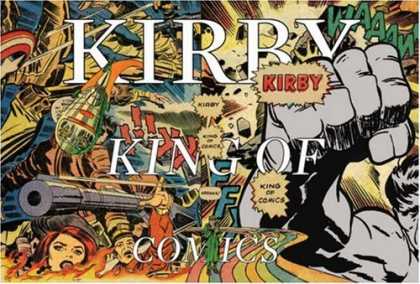
11.09 Kirby: King of Comics by Mark Evanier

Kirby: King of Comics (2008) by Mark Evanier

You can't talk about comics or the history of comics without mentioning Jack Kirby. I'd always been aware of Kirby, knew his style and influence but for some reason assumed that he was one of many of the founding fathers of the comic industry. Thank goodness I read this biography because it schooled me on his true influence.

Kirby wrote and drew comics for nearly 50 years. He was there at the inception of what we call comic books today which were stand alone digest size stores often in multi issue arcs rather than just collections of newspaper strips. In those days artists worked in virtual sweatshop environments cranking out whatever was required of them. Kirby's big break came when he and Joe Simon created Captain America for the proto-Marvel comics company.

No one could match the pace or quality of Kirby's output for a large portion of his career. When he knew he was going off to fight in WWII he drew a huge backlog of comics that could be released while he was gone. After the war he worked on any genre that would pay: boys adventure, romance, war, superhero, science fiction, western.

Eventually Kirby connected with Stan Lee back at Marvel. The author clearly has a thing against Stan Lee and it is hard to know how true some of hes assertions are. What is clear is that Lee was much better businessman than Kirby and although they may have co-created a number of characters, Lee seemed to get the lions share of the credit. This period in the 60s was the creative apex of Kirbys career. Thor, the Hulk, Iron Man, the original X-Men, the Silver Surfer, Doctor Doom, Galactus, Magneto, and the Black Panther were all titles that built Marvel into a successful company.

Kirby continued to work for Marvel, DC and other independents right through until the early 1990s through failing health and eyesight. Not may of the titles through this period were very successful commercially.

Jack Kirby was a terrible businessman and was exploited (or at the very least under-compensated) throughout his career. The terrible irony now is that multi-million dollar movies are being made one after another about characters that he created or co-created: Hulk, X-Men, Captain America Thor. I sure hope that his family are making some loot off them.


Sunday, April 24, 2011

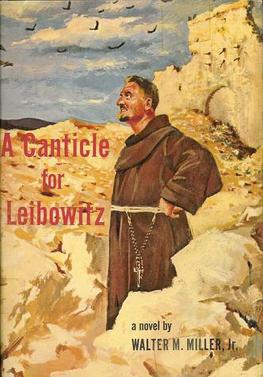
11.08 A Canticle For Leibowitz by Walter M Miller Jr.

A Canticle For Leibowitz (1960) by Walter M Miller Jr.

I have been wanting to revisit this book now for a number of years as I explore the post-apocalyptic literature genre. I know I read it as a teen but really had no memory of what it was about at all. A Canticle For Leibowitz was something of a one hit wonder in that this book was a huge hit for Miller and other than a forgotten sequel written years later he never wrote another novel. Miller was a prolific writer of short stories and contributed to many of the early sf magazines. Canticle is actually three short stories that he repackaged with some adjustments as a novel.

In fact, the structure brought to mind a series of paintings that I was recently introduced to by a friend, The Course of Empire by Thomas Cole. The paintings depict the rise and fall of a city from a "savage" state through its rise and eventual destruction to desolation. Canticle begins after a nuclear apocalypse - the Flame Deluge - where monks of the Albertian Order of Leibowitz have an abbey in the desert. The monks have struggled to preserve the fading knowledge of a the once great civilization of the ancients. Faced with the constant danger of extremists who believed that exposure to knowledge of the ancients would cause another chaotic world event, they had to secure this information of the ancients; often risking their lives to save it.

The novel explores a number of themes including church v state, religion v science, limitations of technology, and others. At times, the more abstract side of the writing especially about religion can become a bit tedious. It's not proselytizing but the author certainly wants to get deep into it. In the end the message is that information is our most precious resource (quite relevant today). Although perhaps not the most readable book ever but certainly well worth for any fan of classic sf or good writing.

Sunday, April 03, 2011

11.07 The Guineaman by Richard Woodman

The Guineaman (2000) by Richard Woodman
Severn House Publishers

Following quickly upon the heels of reading the exciting Bolithio book I picked up this seafaring novel from the library. The Guineaman was very different tale in many way but an equally interesting read about the mid eighteenth century.

William Kite, the hero of this series is the feckless son of a town apothecarist. One dark and stormy night he is forced to flee the scene of a horrible crime and heads to the coast where he joins a slaving ship, a guineaman. I was well prepared after having read a similar book previously for the wide scope of these books but this one really went for the James Michener style sweeping saga.

Kite joins the ship as a "surgeon" and has to deal with yellow fever among the crew and the terrible conditions among the slaves chained below decks. He takes the moral high road by abhorring the treatment of the slaves especially the rapes of the women by the captain and crew. Strangely though, he ends up falling in love with one of the slave girls and ends up taking her and leaving the ship in the West Indies. The story takes another bunch of arcs with Kite becoming a wealthy merchant, ships captain, trader. He eventually heads back to England with his black bride to attempt to clear his name and start a new life.

As an adventure story there were parts of the book that satisfied but way too much stuff was going on. Kite seemingly lurched from one major set piece to anotherand typically came out of it smelling like roses. The book was well written but this was not a character that I thnik I will pursue much further.


Thursday, March 17, 2011

11.06 Richard Bolitho, Midshipman by Alexander Kent

Richard Bolitho, Midshipman (1975) by Alexander Kent
Kindle

I'm in the midst of prepping to play in a play-by-post roleplaying game with some friends. The game is called Beat to Quarters and its setting is in the British Navy in the late 18th century. I really know very little about the era or milieu so I thought I should check out a couple of books. The ones I am familiar with by reputation, of course, are the Master and Commander series by O'Brien and the Horatio Hornblower books. I wanted to look outside these novels I guess because they are being fairly actively read and reviewed by my circle of friends.

This turns out to be the second book in the series about Bolithio. So although he is still a young and inexperienced midshipman he has one voyage under his belt and isn't entirely green. The story begins briskly with Bolithio making friends with another midshipman, Martyn Dancer, at an inn in Portsmouth. Turns out that they are shipmates because a lieutenant from their ship the Gorgon bursts in and orders them aboard. The Gorgon sails to West Africa where they encounter an empty Merchantman, the City of Athens. The captain deduces that pirates have pillaged the ship and reveals that he is on a mission to to investigate the disappearance of ships in the region. I won't reveal more but there is action aplenty throughout the book with sea battles, night raids and several other daring escapades.

I was actually quite taken with this novel. The characters are well drawn and the pace quite relentless. Very enjoyable.


Tuesday, March 08, 2011

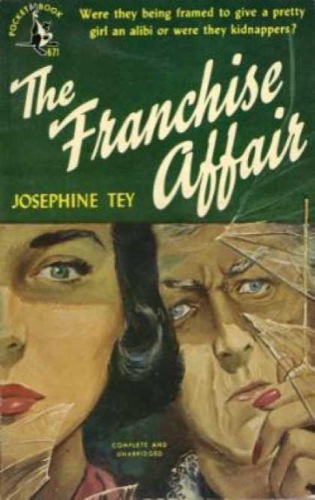
11.05 The Franchise Affair by Josephine Tey

The Franchise Affair (1948) by Josephine Tey
Paperback

Recently I was perusing lists of the top 100 crime novels of all time put out by the Crime Writers Association and the Mystery Writers of America. I consider myself a pretty avid crime reader however I was surprised to see an author who showed up a couple of times near the head of both lists: Josephine Tey. Turns out that her books are not reprinted much and are a bit hard to track down. I did manage to locate The Franchise Affair though.

The Franchise Affair is pretty tame as far as mysteries go but it was still an engaging read. The story is actually based on a notorious abduction case from the 18th century. Robert Blair , a small town lawyer, is called upon to represent 40ish Marion Sharpe and her aged mother when the police bring kidnap charges against them for allgedly seizing a schoolgirl named Betty Kane, imprisoning her in the attic of their large, remote country home known as The Franchise, then forcing her to work as their servant by starving and beating her until she escapes and turns them in. Blair champions the Sharpes cause but public opinion is firmly against them.

Tey's characters are believable, the plot is absorbing, but what makes this book work well is how she successfully plunges her readers immediately not only into the crime, but into the mounting apprehension surrounding the case up until the end. And although The Franchise Affair is set in the countryside, it is a sophisticated story, not just another British country house-based mystery.


Thursday, February 17, 2011

11.04 The Russian Girl by Kingsley Amis

The Russian Girl (1992) by Kingsley Amis
Trade, Penguin

I was looking around in the local used bookstore for some Kingsley Amis that I had never read before. The guy said that this one rarely ever came in to the shop and so I picked it up, intrigued. It is from nearly the end of Amis' bibliographywhich I was not aware of at the time but now seems a bit obvious. The writing doesn't have that crispness that you see in Lucky Jim or The Anti-Death League.

Nevertheless, what Amis writes well about Englishness or more particularly those detailed social interactions that are so particular to the British upper middle class. That class is ably represented by Richard Vaisey, a Russian scholar at the London Institute of Slavonic Studies. He's an intellectual, repressed bourgeoisie married a wealthy and manipulative woman but thoroughly satisfied with his lot. The Russian girl he meets is Anna Danilova, a poet visiting England to raise support for a petition to free her brother, a petty thief unfairly held in a Soviet prison. Anna's poetry is sort of comically bad and Richard's struggle is with his attraction to her and his loathing of her poetry.

The situation will be familiar to anyone who has ever compromised their integrity for love. I can't say that I loved this book although it was interesting. In the end it seemed a bit too much like it was mocking the intellectual pretentiousness that Amis represented himself.

Friday, January 28, 2011

11.03 The Fatal Foursome by Frank Kane

About Face (1947, AKA Death About Face, The Fatal Foursome) by Frank Kane
Paperback, Dell

I collect a lot of old pulp paperbacks, mainly in the sci-fi and crime genres, but I don't tend to read a lot of them. Many are just too old to safely read, some I have more for the cultural value but mainly I just have too damn many other books to read. Occasionally, I'll get an up-condition dupe and that allows the crappier one to become a reading copy. I've always loved the look of these Victor Kalin drawn mysteries by Frank Kane.

The thing is, when you read a 1947 hard boiled detective novel it often comes across as being pretty derivative from the modern perspective. Of course, at that time they weren't really derivative stories at all. At worst, the authors of this era were emulating one another and writing to sell. Kane was a prolific journeyman writer during the pulp era. Among other things he wrote a huge number of short stories for the pulps and featured his detective Johnny Liddell in over 30 novels. Unfortunately, Kane's reputation has never been as glossy as some of his peers like Hammett or Chandler. Thrilling Detective writes of the Liddell series: "a solid series, nothing really exceptional, but it gets the job done, sorta like Johnny."

In The Fatal Foursome, Liddell is sent out from the east coast to Hollywood to investigate the seeming disappearance of an up and coming actor. In the course of his investigation three more bodies turn up right around the same places he is. Suspicion is that he is getting too close to the truth. There is some fun stuff in here - the scrappy yet comely cub reporter who is after the story...and Johnny, the hard drinking ME who is an old buddy - especially the characters.

This was the first book in the series by Kane and if it's any indication the Liddell books will always be in the 2nd tier of early crime fiction.

Monday, January 24, 2011

11.02 The White Lioness by Henning Mankell

The White Lioness (1993) by Henning Mankell
Trade, Vintage Crime/Black Lizard


I have been reading Henning Mankell's books about the detective Wallander for a number of years. Wallander is something of the clichéd doughy, sleepless, overworked police investigator. The type is used in various iterations across the world of crime fiction. What makes Mankell's books interesting though is his taught writing and dry Scandinavian perspective. Wallander is a homicide detective in a smaller Swedish town, Ystad, and continually comes up against the problems that plague larger cities. Often a small crime will reveal something like international drug gangs or human smuggling. I also like Wallander because he has the bulldog in him - when he gets going on a hunch there is no stopping him.

There are generally smaller subplots in the novels about his love life or relationships with his daughter and father. As you move through the series one tracks along with the detectives personal ups and downs. I tired somewhat of the series because these personal storylines became much more a part of the books. I returned to this novel, the third, because I had missed it first time around and his earlier books are the best. The books begins simply with the disappearance of a straightlaced Methodist housewife. Her life is so normal and unremarkable that Wallander can't understand why she would have left...unless she was murdered! I liked this novel but somewhere around the halfway point the story switches to South Africa and the perspective of political leaders from the end of apartheid era. It wasn't so much the switch that was jarring (Mankell has a long history living and working in Africa) but hearing the fictional inner thoughts and dialogue from real life people like FW DeKlerk. In the end, although it wasn't his best effort, Mankell managed to pull it all together albeit overloaded with a left wing anti-apartheid theme.

Monday, January 17, 2011

11.01 Surface Detail by Iain M Banks

Surface Detail (2010) by Iain M Banks
Kindle, Orbit Books


The publication of a new Iain M Banks Culture novel is greatly exciting for me. Banks is one of the few contemporary sf writers who keep me interested in the state of the genre and give me faith in the longevity of science fiction. The Culture novels (of which this is the 8th) are not tied together by plot or character but by the universe he has created. The Culture is a fictional interstellar anarchic, socialist, and utopian group of post-scarcity Minds (AI) that exist individually as ships. The universe is populated by an array of other cultures from low-tech to fantastically high-tech but the Culture tends to lord over them all as sort of powerful liberal anarchists.

My simplistic overview does a disservice to the complexity of Banks fictional world. The best thing about Banks Culture books (which are by no means uniformly excellent) is that he has a variety of really cool science fiction ideas and by custom building his universe he can drop them in where he likes.

Surface Detail is quite complex with multiple story lines, timelines and an array of characters. The book rewards diligent and consistent reading but is quite rewarding towards the final third as the overall plot threads come together. My only complaint would be that I felt a couple of the threads lost some of their narrative steam towards the end. Banks argues in an interview that some of the characters "end up working almost as a Greek chorus, commenting upon the action rather than taking part in it."

Nevertheless, this was a really great book and definitely a worthwhile read for those interested in the genre. As Banks says,

You do have the whole galaxy to play with, and you have the full panoply of types of planets to play with, not just rocky, watery planets. You’ve got no excuse for getting bored with it!